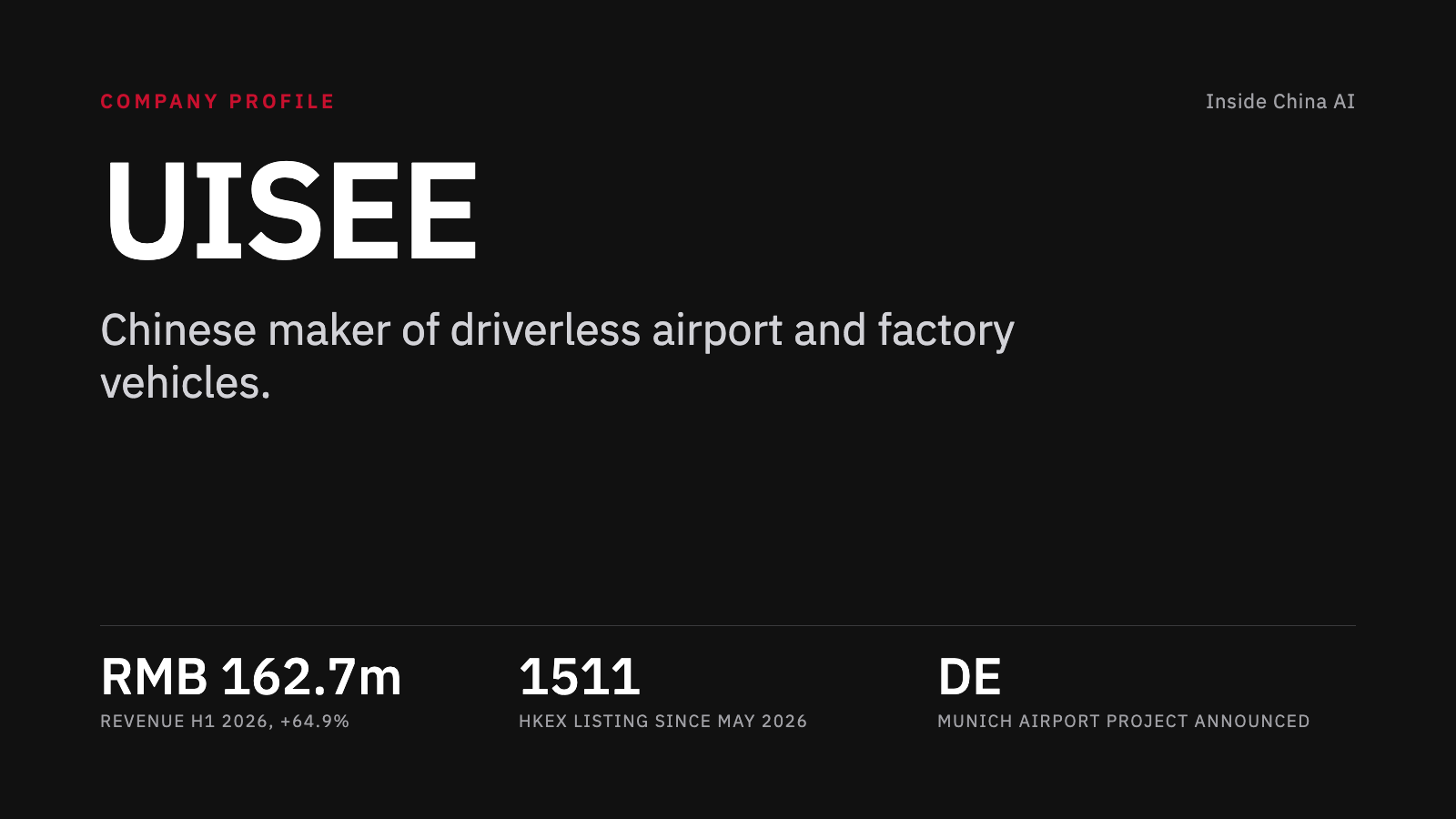
Graphic: Inside China AI
UISEE: Driverless Airport Tractors From Hong Kong to Urumqi, and a First Announced Project in Munich
Company profile · 28 November 2026.
UISEE Technology (驭势科技) builds driverless tractors, shuttles and delivery vehicles for airports and factories, and has run them without safety drivers at Hong Kong International Airport for years. Listed in Hong Kong since May 2026, the Beijing company now says Europe is next: it announced a partnership with Lufthansa in September 2026 and a first Level 4 project at Munich Airport. Its filings show what that means today. Almost all revenue still comes from mainland China and Hong Kong, it has no European office, and its European plans so far consist of negotiations, a pending CE certification and a pilot that has not yet started.
Origins and backing
UISEE was founded in Beijing on 3 February 2016 and became a joint-stock company in November 2024 (prospectus). Its chairman and chief executive, co-founder Wu Gansha (吴甘沙), worked at Intel’s China Research Centre from 2000 to March 2016, leaving as its general manager, according to the prospectus. The company’s interim results of 27 August 2026 confirm that he still holds both roles (HKEX).
The H shares have traded on the Main Board of the Hong Kong stock exchange since 20 May 2026 (stock code 1511). The listing used the exchange’s Chapter 18C rules for specialist technology companies (prospectus). UISEE sold 14.46 million shares at HK$60.30 and raised gross proceeds of HK$872.0 million (allotment results). Before that, according to the prospectus, it had raised more than RMB 1.735 billion from private investors.
Wu and three other co-founders vote together under an acting-in-concert arrangement, joined by Beijing Simaju, a partnership whose general partner is Wu and which holds shares for the beneficiaries of the company’s pre-IPO share-option schemes. At the listing this group held 32.35 per cent of the shares (prospectus). On 12 October 2026 Wu bought further shares and then held about 24.69 per cent of the H shares (HKEX). The prospectus names Dongfeng Asset Management among its strategic investors. The shares have been tradable through Southbound Stock Connect since 7 September 2026 (HKEX).
What they build
UISEE describes itself as “a provider of autonomous driving solutions specializing in driverless Level 4 (“L4″) technology in Greater China” (interim results). It sells in four ways. It supplies complete driverless vehicles, mainly tractors for baggage, cargo and factory logistics plus shuttles. It sells kits that make customers’ own vehicles driverless, as well as custom software. It also leases vehicles. Its platform is called U-Drive. The interim results name Hong Kong International Airport, Singapore Changi Airport, Guangdong Airport Authority Logistics and Urumqi Tianshan International Airport as airport users.
Some of the scale is documented in stock exchange filings. In Urumqi, UISEE has deployed more than 70 vehicles, and the fleet has passed one million kilometres in commercial operation (HKEX). In the first half of 2026 the company ran more than 100 vehicles without drivers for one mainland airport customer and began “formal unmanned operations” at Changi, according to its interim results. There, a July 2025 agreement covers the lease of 20 vehicles until the end of 2027 (prospectus). At Hong Kong airport, more than 70 UISEE vehicles have covered over four million kilometres in seven years, the company says (UISEE).
A second business supplies driver-assistance software for passenger cars. In October 2026 UISEE said it had provided software for the new Buick LaCrosse and Cadillac XT5 variants in China (HKEX). In May 2026 it supported the start of production of a right-hand-drive Seres model, the Landian E5 Plus, in Indonesia (HKEX).
On AI, the company says it is developing vision-language models, end-to-end driving based on vision-language-action models, and “spatial world models”. It also plans to move customers from buying kits to “AI Driver subscription services” (interim results). We found no named, published UISEE model.
Key numbers
- Listing HKEX Main Board (1511) since 20 May 2026; IPO gross proceeds HK$872.0 million (allotment results)
- Revenue RMB 161.4 million (2023), RMB 265.5 million (2024), RMB 328.3 million (2025); loss for the year RMB 230.2 million in 2025 (prospectus)
- First half 2026 Revenue RMB 162.7 million (+64.9%), gross margin 52.9%, loss RMB 126.4 million, R&D spending RMB 117.2 million; cash RMB 801.1 million at 30 June (interim results). UISEE reports half-yearly and publishes no third-quarter figures.
- Where revenue comes from H1 2026: RMB 150.9 million from mainland China, RMB 9.6 million from Hong Kong, RMB 2.3 million from other markets (interim results)
- Staff 459 full-time employees at 30 June 2026, in mainland China, Hong Kong, Singapore and Qatar (interim results)
- Market position No. 1 L4 provider for commercial vehicles at airports (90.5% share) and in factories (31.7%) in Greater China by 2025 revenue, according to an industry report by Frost & Sullivan that the company commissioned for its prospectus
The European angle
- Lufthansa and Munich At the GSE Expo Europe ground-handling fair in Lisbon (15–17 September 2026), UISEE “officially announced a strategic partnership with Lufthansa”. According to UISEE, the two companies “will launch their first L4-level autonomous driving collaboration project at Munich Airport” (UISEE). The announcement gives no start date, vehicle numbers or Lufthansa unit. We found no statement on it from Lufthansa or Munich Airport (search of 27 November 2026). As described by UISEE, it is an agreement and a planned project, not yet an operation or a customer contract.
- Plans, not yet operations The interim report says UISEE will focus on “major aviation markets in the Middle East and Europe”. “With the CE certification process progressing as planned”, it expects trial operations for several projects in these markets during 2026 (interim results). In May 2026 the prospectus listed Germany, Italy, Spain, Switzerland and Hungary as target countries. It said UISEE had “initiated negotiations with leading airports in Germany, Spain and Switzerland” and was talking with possible agents or partners in Italy and Hungary. None of them was named (prospectus).
- Physical presence None so far. The company’s staff work in mainland China, Hong Kong, Singapore and Qatar. The IPO plan includes R&D and business-development centres in “Hungary/Italy/France”, among other regions. At 30 June 2026 none of the IPO proceeds had been spent, and the company’s deadline for using them is December 2029 (interim results).
- Certification The prospectus says UISEE obtained an ISO 26262 ASIL-D functional-safety certificate “to facilitate the expansion of our business into Europe” and that CE marking is still in progress.
- Revenue No European revenue is disclosed. In 2023–2025, 98.6 to 99.6 per cent of revenue came from mainland China and Hong Kong (prospectus).
- Lists and rules UISEE does not appear on the EU financial sanctions list, the US Consolidated Screening List or the Pentagon’s 1260H list (name check, 27 November 2026). In its prospectus the company says that, as advised by its international sanctions lawyers, it falls within the definition of a “covered foreign person” under the US rules on outbound investment, because of AI systems used to control robotic systems. It adds that its products are not intended for, and will not be used in, military, government-intelligence or mass-surveillance end uses.
- What a European buyer would actually encounter For now, a sales pitch and an announced pilot. Over several years UISEE has built driverless airport logistics at scale in Hong Kong, Urumqi and Singapore. Whether that model can work in Europe will first be tested in Munich, under CE marking that is not yet complete.
What we could not verify
- The Lufthansa partnership from Lufthansa’s side, including which group company is involved, when the Munich pilot starts and whether Munich Airport is a party.
- Whether CE marking has been granted by the end of November 2026.
- Which German, Spanish and Swiss airports UISEE is negotiating with, and who its possible partners in Italy and Hungary are.
- Who issued the ASIL-D certificate. The prospectus names TÜV Rheinland (December 2022). UISEE’s own news item of 2 February 2023 says TÜV SÜD awarded an ISO 26262 ASIL D product certificate for its multi-sensor data fusion software, and an HKEX announcement of 2 June 2026 also names TÜV SÜD (HKEX). Whether these are two certificates or one, the company has not said.
- The company’s own totals of more than 11.2 million driverless kilometres, more than 1,000 vehicles and 21 airports (October 2026). These come from its website and are not in its filings.
The open question for Europe: will the Munich project become the first driverless UISEE fleet on a European apron, and will Lufthansa confirm it?

Comments are closed