Graphic: Inside China AI
Black Sesame Technologies: The Wuhan Chip Designer Moving from Driver Assistance to On-Device AI
Company profile · 28 November 2026.
Black Sesame Technologies (黑芝麻智能) designs the computing chips that run driver-assistance software in cars from BYD, Geely, Dongfeng and FAW, and it now wants to be, in its own words, “the world’s strongest on-device AI inference solution provider”. It has signed memoranda of understanding with Continental and the audio software company Dirac, uses Elektrobit software tools and showed its chips at IAA Mobility in Munich – but it has no company, office or named customer in Europe. Its revenue is rising quickly, and its losses remain large: its interim report for 2026 discloses a material uncertainty about its ability to continue as a going concern, while the directors expect sufficient funding for the following twelve months.
Origins and backing
Shan Jizhang and Liu Weihong founded the company in July 2016 (HKEX announcement, 30 January 2026). Shan, who worked at the image-sensor maker OmniVision from 1997 to 2016, last as a vice president of software engineering, is chairman and chief executive (2025 annual report). Liu, a former regional president at Bosch’s automotive unit in Suzhou, gave up the post of president on 29 January 2026 and became a non-executive director and consultant.
The group’s headquarters are in Wuhan (company website), and its listed holding company, Black Sesame International Holding, is registered in the Cayman Islands. Its shares have traded on the Main Board of the Hong Kong Stock Exchange (code 2533) since 8 August 2024. According to the 2025 annual report, Shan’s interests amounted to 12.95 per cent of the shares at the end of 2025, and the board knew of no other shareholder above the reporting threshold.
The company relies on new shares and bank loans. In May 2026 it completed a subscription of 33.5 million new shares at HK$18.88 each with Infini Global Master Fund, raising net proceeds of about HK$632.4 million (interim results); by 23 November 2026 core employees had bought shares worth about HK$53 million on the open market with their own funds (HKEX announcement, 23 November 2026). In mid-2026 it completed the takeover of 60 per cent of Zhuhai Eeasy Technology, a maker of low-power AI chips, according to the same report of 31 August 2026.
What they build
Black Sesame does not build AI models for the public. It designs chips and the software around them so that carmakers’ and robot makers’ AI models can run on the device. It has three lines, according to its interim results:
- Driver assistance. The Huashan A1000 chip is in vehicles from Geely, Dongfeng, BYD and FAW, and the company says it had “begun to penetrate into global markets” in 2025, without naming any (2025 annual results). The more powerful Huashan A2000 family – four chips covering 200 to 1,000 TOPS, with a self-developed NPU called Jiushao designed for large models (company news, 30 October 2026) – has design wins at Dongfeng, Yutong and Chery and is due to enter mass production in the second half of 2026, the company says. It ships with “end-to-end/Vision-Language-Action (VLA) reference models” and works with algorithm partners such as DeepRoute.ai and Nullmax. The Wudang C1200 series combines cockpit and driver-assistance functions on one chip and is used in Dongfeng’s Tianyuan cockpit platform.
- Robots. The SesameX platform, with modules from 48 to nearly 700 TOPS, ships in volume for robot arms, collaborative robots and quadruped inspection robots, the company says; a module for humanoid robots has completed algorithm validation with humanoid makers and is about to go to sample testing. The company names Midea and COSCO Shipping as strategic partners. On 19 November 2026 it opened a headquarters for its embodied-AI business in Shenzhen’s Qianhai district (company news).
- AI servers and devices. In October 2026 the company announced its first orders for AI computing servers built on its own chips: contracts worth about RMB 300 million with an unnamed A-share-listed company (HKEX announcement, 14 October 2026). Together with Eeasy, the group plans to take its low-power chips into home appliances, action cameras, gimbals and AI glasses.
Export controls shape the story. In its 2025 annual report the company says the A2000 completed tape-out after “the relevant review” and that it became “the only company in China to have passed such reviews and gained the ability to sell such chips globally”. On 24 November 2026, after what it called industry news drawing market attention, the company stated that the A2000 had passed a review by the US Bureau of Industry and Security (BIS) at the end of 2025 and was approved for sale worldwide, and that its business was proceeding as planned (company statement). Both are the company’s own statements; we have not seen a BIS document confirming them.
Key numbers
- Listing Hong Kong Stock Exchange, code 2533, since 8 August 2024
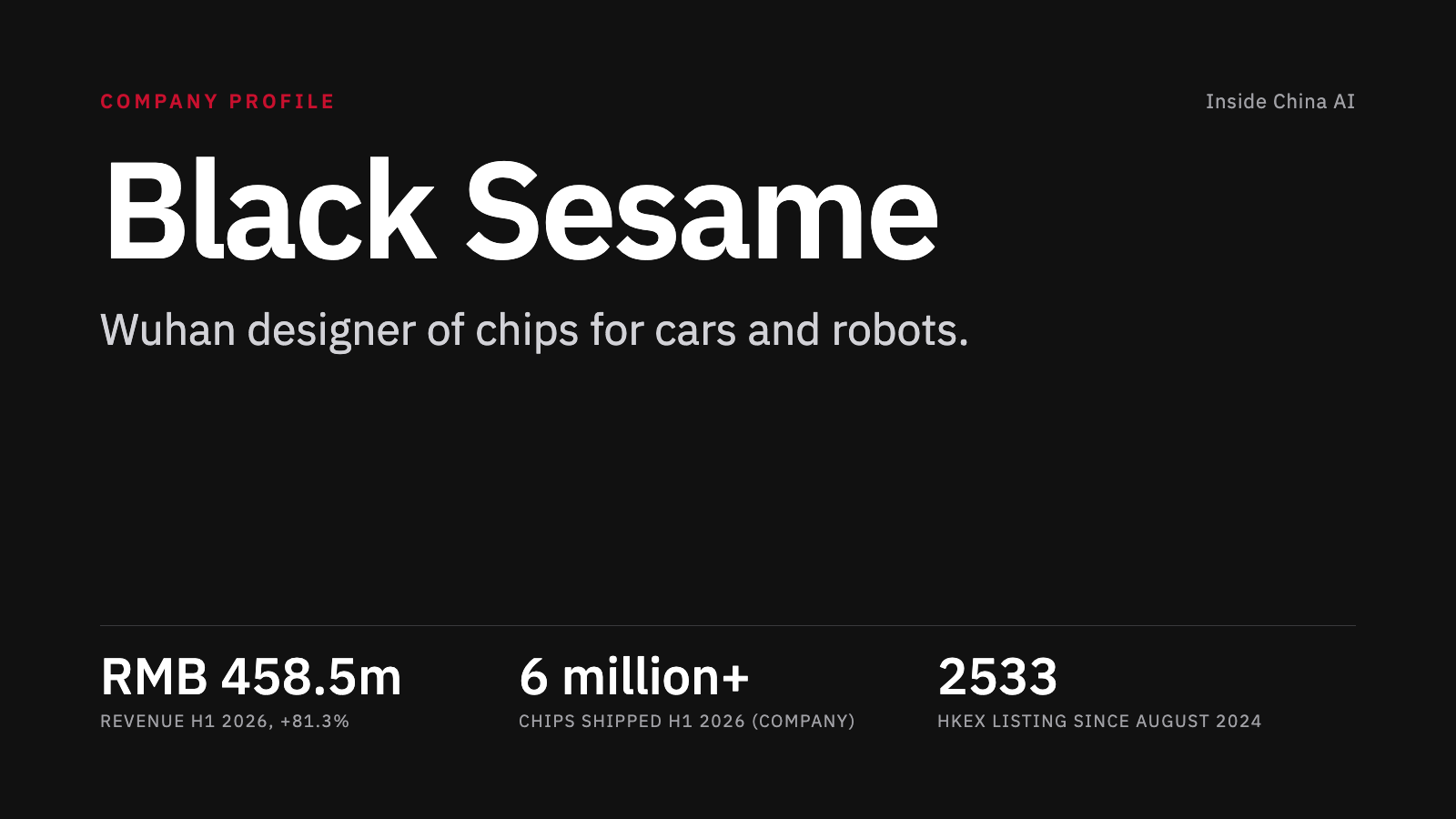
- Revenue RMB 458.5 million in H1 2026 (+81.3%); RMB 822.3 million in 2025 (+73.4%)
- By business, H1 2026 driver assistance RMB 395.1 million; embodied AI RMB 47.2 million; imaging RMB 16.2 million
- Loss RMB 770.3 million in H1 2026; RMB 1,424.7 million in 2025
- R&D spending RMB 859.7 million in H1 2026 (+39.1%)
- Cash and current financial assets RMB 1,268.2 million at 30 June 2026
- Chips shipped over 6 million in H1 2026, the company says
- Employees 1,133 at 30 June 2026
All figures are from the interim results of 31 August 2026 and the 2025 annual results. Black Sesame reports half-yearly; it has published no third-quarter figures. In the same interim report the company lists, at 30 June 2026, accumulated losses of RMB 13.36 billion and current liabilities of RMB 1.80 billion, including borrowings of RMB 671.3 million, and states that “a material uncertainty exists that may cast significant doubt on the Group’s ability to continue as a going concern”. In the opinion of the directors, the group will have sufficient financial resources for the twelve months from 30 June 2026; they cite new bank loans of RMB 357 million obtained after that date, cost control and further private share placements, and therefore prepared the accounts on a going-concern basis.
The European angle
- Physical presence None. The 2025 annual report lists subsidiaries in China, Hong Kong, Singapore and the United States, and R&D centres in China, Silicon Valley and Singapore – none in Europe. In 2026 the company set aside HK$126.5 million of its May share proceeds for “overseas research and development centers” without saying where; none of it had been spent by 30 June.
- Partners In February 2022 Black Sesame adopted Elektrobit’s AUTOSAR Classic Platform and EB tresos tools for software development on its autonomous-driving platform (company news). At CES in January 2025 it signed a memorandum of understanding with Continental on high-performance vehicle computers; according to the company, it gives Continental early access to chip samples, evaluation kits and software, and the two will look for new business together, including joint exploration of the Chinese market (company news, 21 January 2025). On 21 January 2025 it also signed a memorandum with the audio software company Dirac to explore integrating Dirac’s digital audio software into its Wudang C1200 chips (company news, 22 January 2025). We found no product from either memorandum.
- Trade fairs Black Sesame exhibited at IAA Mobility in Munich in September 2025, according to its annual report. There it presented its C1200-based safety platform for cockpit and driver assistance to an international audience for the first time, the company said (press release via Huanqiu).
- Customers No European customer is named. The company says its A1000 chips reached “global markets” in 2025 and that it will push the A2000 into “overseas vehicle projects”, but it does not name any countries. The annual report gives no regional revenue breakdown because most revenue is earned in China.
- Lists We found no entry for Black Sesame on the EU’s consolidated financial sanctions list, the US Consolidated Screening List (including the Entity List) or the US Defense Department’s 1260H list (name check, 27 November 2026).
- What a European buyer would actually encounter If anything, a Black Sesame chip inside a Chinese-built car or robot. The public record shows no direct supplier relationship with a European carmaker or robot builder.
What we could not verify
- Whether any car sold in Europe carries a Black Sesame chip. Several of its customers export to Europe, but no source links a European model to its chips.
- The US review of the A2000 beyond the company’s own statements, and which industry news prompted its statement of 24 November 2026.
- The status of the Continental and Dirac memoranda. Neither the company nor its partners have announced a product or supply contract from them.
- Where the planned overseas R&D centres will be.
The open question for Europe: will the A2000 reach European roads inside Chinese export models, or will Black Sesame sign a European carmaker or supplier as a direct customer?

Comments are closed