Graphic: Inside China AI
United Imaging Healthcare: China’s Scanner Maker Builds Its AI Into the Machine — and Meets an EU Procurement Barrier
Part of The Model Layer — profiles of the Chinese AI companies Europe is about to meet. Company profile · 21 November 2026.
United Imaging Healthcare is China’s listed maker of MRI, CT, PET and radiotherapy machines, and it sells its AI not as an app but inside the hardware. In Europe its scanners now run in Leuven, Madrid, Kiel and Dresden, according to company press releases, and its European revenue grew by almost half in the first half of 2026. At the same time, since 30 June 2025 the EU has excluded Chinese suppliers from public tenders for medical devices worth 5 million euros or more — the first measure under its International Procurement Instrument. For European hospitals, the question is less whether the machines are good enough than whether public buyers are still allowed to choose them.
Origins and backing
Shanghai United Imaging Healthcare (上海联影医疗科技股份有限公司, 联影医疗) was founded in Shanghai in 2011, the company says (investor relations). It listed on Shanghai’s STAR Market under the code 688271 on 22 August 2022, selling 100 million shares at 109.88 yuan in what Reuters called the biggest STAR Market offering of that year so far (Reuters via Yahoo Finance).
A co-founder still holds control. Xue Min (薛敏) founded the company with Zhang Qiang in Shanghai in March 2011 (Pedaily). According to the third-quarter report, Xue Min is the company’s actual controller; he controls the largest shareholder, United Imaging Group, with 20.33 per cent, and Shanghai Yingsheng Investment, with 7.30 per cent. The second-largest shareholder is Shanghai Lianhe Investment, listed as a state-owned legal person, with 16.38 per cent (Q3 2026 report).
The leadership was renewed in November 2026. On 13 November the new board re-elected Zhang Qiang (张强) as chairman and appointed him co-chief executive alongside GuoSheng Tan, who is also general manager; Jun Bao became president and Hongdi Li, chief executive of UIH America since 2013, became chief technology officer (board announcement of 14 November 2026). The company had over 9,300 employees at the end of June 2026, 40 per cent of them in research and development (2026 half-year report).
One distinction matters for anyone mapping Chinese medical AI. The software company United Imaging Intelligence (联影智能), which develops the uAI applications and a medical foundation model, is not a subsidiary of United Imaging Healthcare. The half-year report lists it as a related party, “an enterprise controlled by the actual controller” — a sister company under Xue Min, not part of the listed group. We cover it in a separate directory entry.
What they build
United Imaging Healthcare makes “high-performance medical imaging equipment, radiotherapy products, and life science instruments”, according to its half-year report: MRI, CT, X-ray, molecular imaging (PET/CT, PET/MR), ultrasound, interventional systems and linear accelerators. It produces in Shanghai, Changzhou, Wuhan and Houston in the United States. At the end of June 2026, 77 of its products carried EU CE certification and 78 had US FDA 510(k) clearance, the report says.
Its AI sits in the machines. The company says it “embeds artificial intelligence into all equipment lines from the product definition stage”, through platforms named per modality: uAIFI for MRI, uSense for CT, uExcel for molecular imaging, uVera for interventional imaging and uEDGETEC for ultrasound. The functions are workflow tools — automatic patient positioning, faster reconstruction, quality control, and on the uRT-linac 506c radiotherapy system automated contouring and treatment planning (United Imaging Healthcare Europe). The company also says it is developing “disease-specific intelligent agents” for cancer and neurology with Chinese hospitals, and describes AI as moving “from a tool for image recognition and feature annotation to an intelligent decision support system” (half-year report). We found no foundation model of its own in its filings; the medical foundation model in the group belongs to United Imaging Intelligence.
In Europe the two companies appear together. When HT Médica opened a 5-tesla MRI scanner in Madrid in September 2026, the press release said the clinic also has access to “the uAI platform from United Imaging Intelligence, which includes 31 CE-marked AI applications” (United Imaging Healthcare Europe).
Key numbers
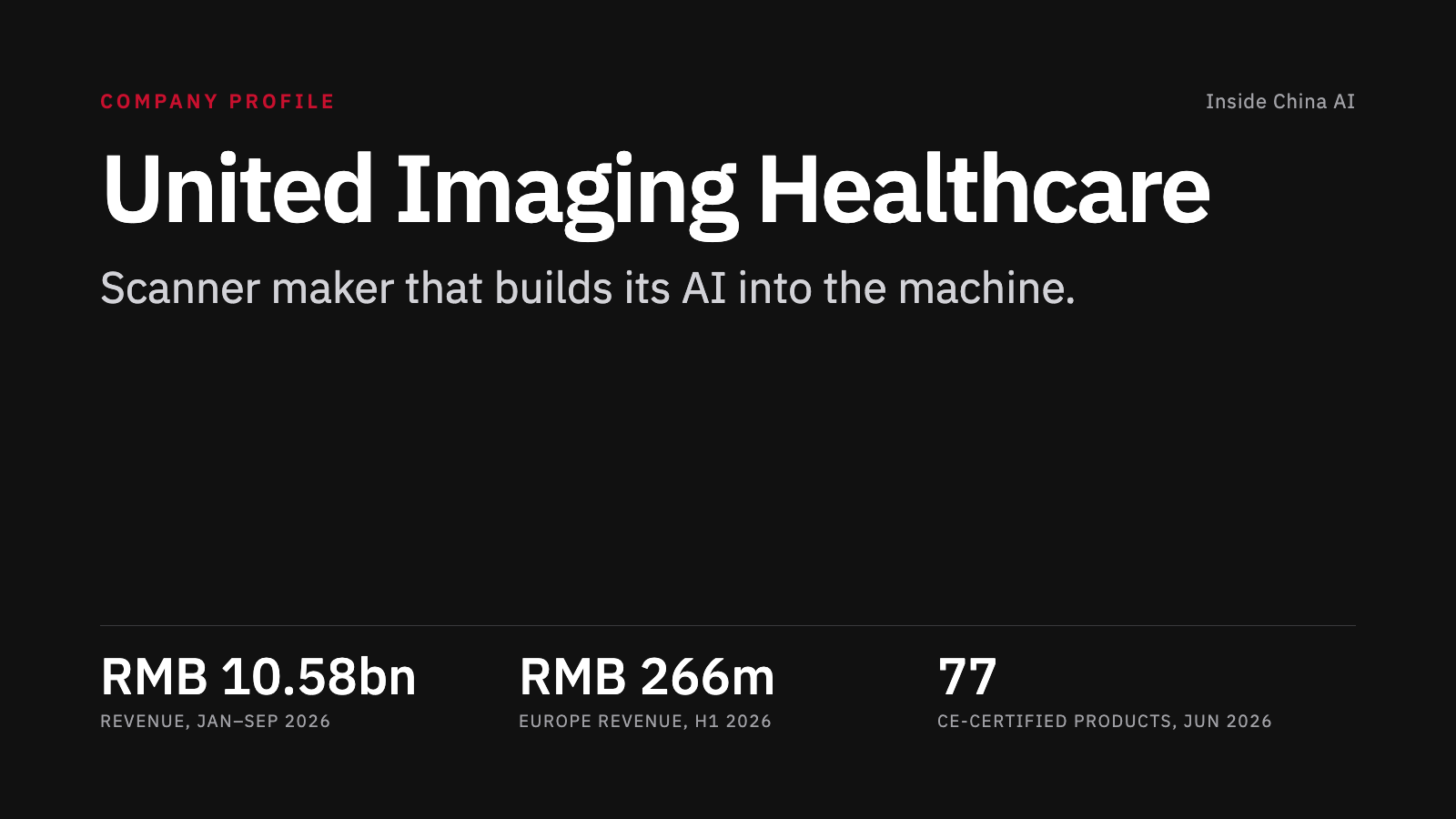
- Revenue 10.58 billion yuan January–September 2026, up 19.43 per cent; third quarter 3.53 billion yuan, up 24.12 per cent (Q3 report)
- Net profit attributable to shareholders 1.04 billion yuan January–September 2026, down 7.60 per cent; third quarter 138 million yuan, up 13.00 per cent (Q3 report)
- R&D 2.23 billion yuan January–September 2026, 21.08 per cent of revenue (Q3 report)
- Overseas 1.77 billion yuan in the first half of 2026, up 54.46 per cent and 25.02 per cent of revenue; Europe 266 million yuan, up 49.37 per cent (half-year report)
- Currency A foreign-exchange loss of 118 million yuan in the first half, against a gain of 15 million a year earlier, explains much of the profit decline, the company says (earnings call summary)
- Owner Xue Min controls 27.6 per cent through two vehicles; Shanghai Lianhe Investment (state-owned) 16.38 per cent (30 September 2026)
- AI AI platforms built into each scanner line; 77 products with CE certification (30 June 2026)
The European angle
- Physical presence Yes. The European headquarters is United Imaging Healthcare Europe B.V. in Rotterdam (contact page). The half-year report lists subsidiaries in Poland, Spain, Italy, France and Germany as well as a Dutch holding company; on the earnings call the company spoke of “nearly 10” subsidiaries and offices in Europe and a local team of more than 160 (earnings call summary). All of the company’s production sites are in China and the United States.
- Customers UZ Leuven and KU Leuven in Belgium use a NeuroEXPLORER brain PET scanner from the company in clinical practice; by 11 June 2026 it had been running for six months and had imaged over 400 patients, the company says (press release). HT Médica and San Rafael University Hospital in Madrid opened what the company calls “Europe’s first 5 Tesla MRI unit” on 28 September 2026 (press release). The German imaging provider Beyond Imaging runs the company’s CT and 3-tesla MRI systems in its new centres in Kiel and Dresden, according to a company press release (press release). UPMC, a US hospital group with operations in Italy, agreed in May 2026 to bring the uRT-linac 506c radiotherapy system to Italy, in what the two partners call “the first installation of its kind in Europe” (press release).
- Scale The company had delivered more than 780 systems in Europe by the end of June 2026, and European service revenue grew by more than 80 per cent in the first half, it says (half-year report). On the earnings call it named France, Germany, Italy and the United Kingdom as its key European markets. New CE marks in 2026 cover two radiotherapy systems and, from September, the uPMR Zenith PET/MR scanner (press release).
- Procurement barrier Commission Implementing Regulation (EU) 2025/1197 of 19 June 2025 excludes tenders “submitted by all economic operators originating in the People’s Republic of China” from all EU public procurement procedures for medical devices with an estimated value of 5 million euros or more, net of VAT. Winning bidders in those procedures may supply no more than 50 per cent of the contract value in devices originating in China. The measure binds all public contracting authorities and contracting entities in the EU and entered into force on 30 June 2025 (EUR-Lex); under the instrument it runs for five years unless extended, and buyers may set it aside where only Chinese tenders meet their requirements or for overriding reasons of public interest such as public health (Regulation (EU) 2022/1031). It is the first measure under the EU’s International Procurement Instrument (European Commission). China answered in July 2025 by excluding EU companies, but not EU-invested companies in China, from Chinese government purchases of imported medical devices above 45 million yuan (JunHe). United Imaging Healthcare’s filings do not name the EU measure; on the earnings call the company said tariffs and geopolitics affect “bidding eligibility” for certain projects. Because its scanners are made in China, even a European bidder can use them for at most half the value of a contract covered by the measure. Purchases by private providers such as Beyond Imaging are not public tenders and fall outside it.
- Lists United Imaging Healthcare is not on the EU consolidated sanctions list, the US Consolidated Screening List, which includes the Entity List, or the Pentagon’s 1260H list, according to our name check of the published lists on 15 November 2026.
- What a European buyer would actually encounter High-end scanners with AI built into acquisition and workflow, sold and serviced from Rotterdam — easiest to buy for private imaging chains and research hospitals, and hardest for public hospitals running large EU tenders.
What we could not verify
- Whether the EU procurement measure has excluded a specific United Imaging bid, and whether the company’s EU subsidiaries count as Chinese operators. Under the instrument, a company’s origin is the country where it is incorporated and carries on substantive business; we found no public decision applying that test to United Imaging Healthcare.
- European revenue after June 2026. The third-quarter report gives no regional breakdown.
- The “first in Europe” claims for the 5-tesla MRI in Madrid and the radiotherapy system in Italy, which rest on company press releases.
- The role of the Polish subsidiary, which the European website marks as a regional headquarters in Warsaw without giving an address there, and whether the company has its own company in the United Kingdom.
The open question for Europe: if the procurement barrier stays, will United Imaging Healthcare’s growth in Europe come mainly from private clinics — or will it build something in Europe that changes how its bids are treated?

Comments are closed