Graphic: Inside China AI
XtalPi: The Shenzhen Drug-Discovery Platform That Sells Robot Labs to Pharma — and Owns a Lab Near Liverpool
Company profile · 21 November 2026.
XtalPi combines AI models with robotic chemistry labs. It designs drug candidates for pharma companies, licenses some of its own, and sells the automated lab equipment it uses. Since June 2025 it has owned a chemistry company in Runcorn, near Liverpool. On 9 November 2026 it signed a research deal with France’s Laboratoires Pierre Fabre. For Europe, XtalPi is easy to misread. Its headline deal is “worth up to $5.99 billion”, but by 27 May 2026 its stock-exchange filings showed $70 million received; almost all the rest consists of milestone payments that are maximums and depend on future success. BASF uses one of its lab workstations, and Roche and Haleon have ordered lab systems. Its UK subsidiary is small, and for Europe that subsidiary is the part to watch.
Origins and backing
XtalPi — 晶泰科技, listed as XtalPi Holdings Limited (晶泰控股) — was founded in 2015 by three physicists from the Massachusetts Institute of Technology, the company states in its filing of 9 November 2026; the company says it started in Boston. Today the holding company is registered in the Cayman Islands and has its headquarters in Futian, Shenzhen, according to its 2026 interim report. Co-founder Wen Shuhao is chairman and co-founder Ma Jian is chief executive. Co-founder Lai Lipeng and Jiang Yide Alan are the other executive directors. The board was unchanged as of 9 November 2026. Since 10 March 2026 the chief financial officer has been Zhou Feiran, formerly of J.P. Morgan (HKEX).
Tencent, through its investment vehicle Image Frame Investment (HK), held 13.66 per cent before the IPO and 12.91 per cent immediately after it, according to the prospectus. On 13 June 2024 XtalPi listed on the Hong Kong Stock Exchange (stock code 2228). It was, the company says, the first company to list under Chapter 18C, Hong Kong’s new route to listing for specialist technology companies (2024 annual results). On 30 June 2026 the largest disclosed holder was Wen Shuhao’s family trust, deemed interested in 15.28 per cent through its vehicle QuantumPharm Holdings. That figure includes 5.16 per cent the vehicle holds directly, 5.44 per cent held for the pre-IPO employee share option plan, and the shares of Ma Jian’s and Lai Lipeng’s holding companies, whose votes the vehicle exercises under powers of attorney. Tencent appears neither in this list of holders of 5 per cent or more nor in the one in the 2025 annual report (interim report). XtalPi has published no current figure for Tencent’s stake. Since the IPO, XtalPi has raised money through three share placings in 2025 and, in January 2026, zero-coupon convertible bonds of HK$2.87 billion that fall due in 2027 (interim results). In October 2026 Wen bought 3.79 million shares on the market for about HK$25 million (HKEX).
What they build
XtalPi has two businesses. In “Drug Discovery Solutions” it designs molecules for partners and licenses its own drug candidates. In “AI4S Intelligent Solutions” (AI for science) it sells robotic laboratories and chemistry services (interim results). The company says it combines four layers: “Genius Agent”, a system of AI agents that plans and coordinates research tasks; “Scientific AI”, its prediction and design models; “Physical AI”, meaning robotic labs; and a proprietary data base. It says it has deployed more than 300 automated workstations worldwide and collected more than 500,000 experimental records, about 80 per cent of them from failed experiments.
The AI models are its own. They include SureRoute for planning chemical syntheses; for antibodies, built by its subsidiary Ailux, the XtalFold, XenProT and Xentient platforms; HELM-DIFF for peptides; and siFormer for siRNA drugs. The company says SureRoute’s rate of “chemical hallucination” was 4.6 per cent in its own test on 350 industrial molecules. The products it sells include synthesis workstations and powder dispensers such as XmartChem and NeoDispenser. These are lab hardware, not AI models. XtalPi also applies the platform outside pharma, for example to perovskite solar cells with JinkoSolar and to battery electrolytes. It sells a hair-care line, Groland, in China.
The pharma deals are large on paper, and the filings give the detail. In the deal with DoveTree, the company founded by the drug developer Gregory Verdine, XtalPi had received “an initial payment of US$51 million” by 5 August 2025. The filing of that date said XtalPi was “entitled to receive a further payment of US$49 million” and eligible for “potential regulatory and commercial milestone payments of up to US$5,890,000,000”, plus potential royalties of a single-digit percentage of net sales (HKEX). On 27 May 2026 XtalPi reported “the second payment of US$19 million”, and one cancer drug candidate was in studies to prepare a clinical trial application (IND-enabling studies) (HKEX). That filing no longer mentions the further $49 million; it repeats the milestones of “up to” $5.89 billion. The “up to $5.99 billion” in the company’s press release equals, by our calculation, $51 million plus $49 million plus the $5.89 billion maximum in milestones. The $70 million reported as received is about 1.2 per cent of the headline figure (our calculation). Eli Lilly signed an antibody deal with Ailux in November 2025. The filing puts its upfront and near-term payments at “tens of millions” of dollars and its total potential value, including milestones, at up to $345 million (HKEX). In June 2026 an unnamed “prominent international biopharmaceutical company” agreed a deal for a small-molecule drug against a GPCR target. Its upfront payment was not disclosed; including potential milestones and royalties, XtalPi puts the “total potential deal value” at “over US$400 million” (HKEX). Lilly is also a customer for lab robots. In the first half of 2026 it signed two lab-automation projects, each worth an eight-figure sum in yuan, and one system was delivered to its Shanghai research centre. XtalPi says it has a strategic collaboration with Pfizer. It reports three partnered or in-house drug programmes in clinical trials.
Key numbers
- Founded 2015 by three MIT physicists; headquarters Shenzhen; holding company in the Cayman Islands
- Listing Hong Kong, 13 June 2024 (2228.HK), first Chapter 18C listing
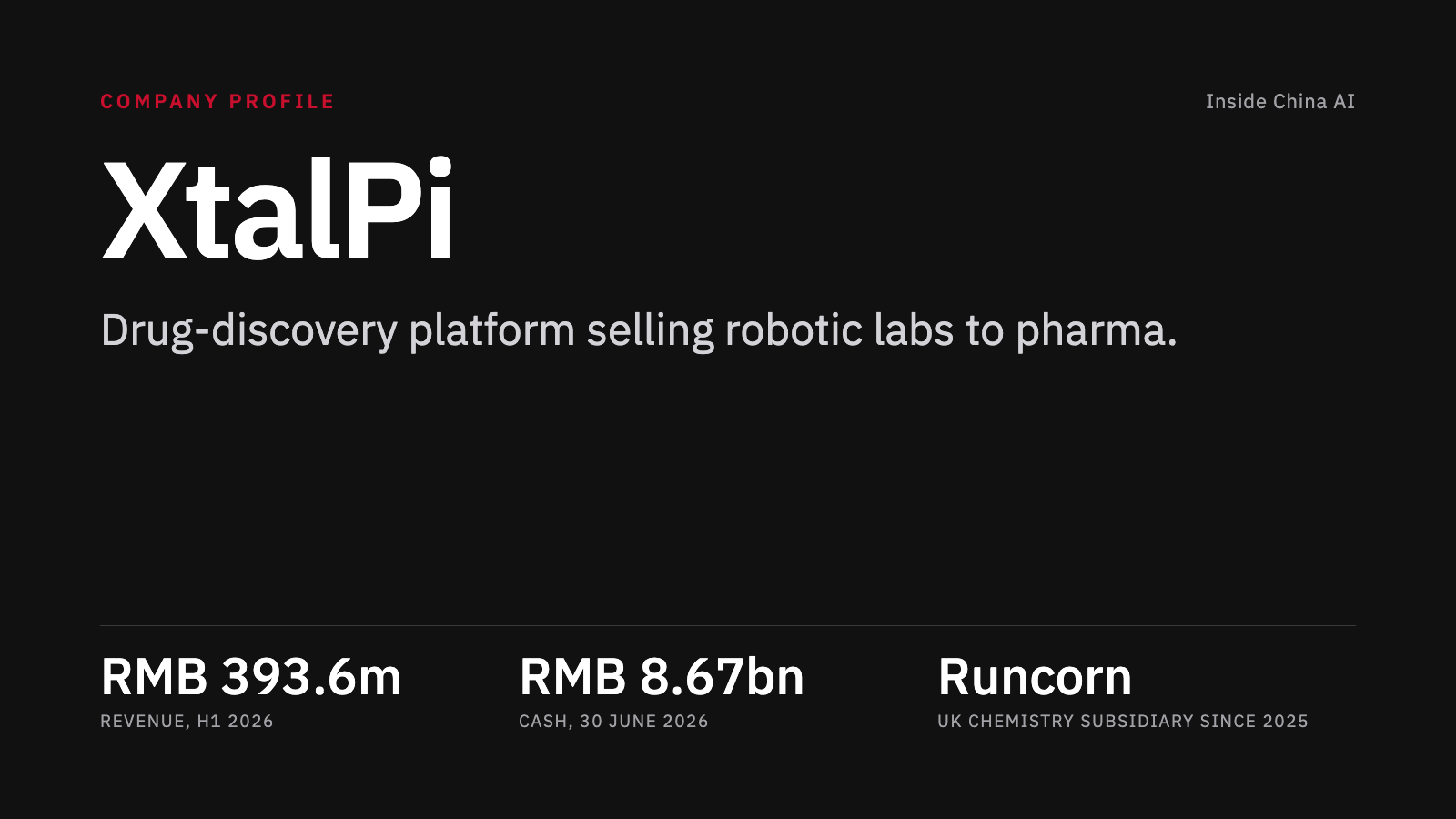
- Revenue H1 2026 RMB 393.6 million, down from RMB 517.1 million; the first half of 2025 included the $51 million initial payment from DoveTree, the first half of 2026 the second payment of $19 million (RMB 129.4 million) (interim results)
- Segments H1 2026 Drug discovery about RMB 200.1 million (RMB 435.2 million a year earlier); robotic labs and services RMB 193.5 million, up 136.4 per cent
- Result H1 2026 Net loss RMB 224.9 million; R&D spending RMB 367.8 million. In 2025 XtalPi made its first annual profit, RMB 134.6 million (annual results). The company attributes the turnaround mainly to higher revenue, to net fair-value gains on financial assets, which reached RMB 514.6 million, and to the absence of the 2024 loss on its preferred shares (profit alert). Without the fair-value gains, the result before tax would have been a loss of about RMB 379 million (our calculation)
- Customers by billing address H1 2026 United States RMB 184.4 million, mainland China RMB 158.6 million, all other regions RMB 50.7 million; Europe is not reported separately
- Cash RMB 8.67 billion on 30 June 2026, including deposits and short-term financial assets
- Staff 1,623 on 30 June 2026 (1,054 a year earlier)
- Quarterly figures XtalPi reports half-yearly; there are no Q3 2026 figures
The European angle
- A subsidiary in England In June 2025 XtalPi completed the purchase of Liverpool ChiroChem, a 2014 spin-out of the University of Liverpool that specialises in automated chiral chemistry (HKEX; University of Liverpool). XtalPi did not disclose the price. The business sits in LCC Technologies Ltd, a wholly-owned subsidiary incorporated on 29 May 2025 and registered at The Heath Business & Technical Park in Runcorn (Companies House). According to XtalPi’s 2025 annual results, it employs “around 20 specialists” there. Its PACE platform combines AI-based design with automated synthesis. In September 2026 LCC Technologies signed a drug discovery collaboration with Stanford University (HKEX).
- Plans in the UK In March 2026 XtalPi’s leaders visited the Liverpool City Region, where the region’s mayor welcomed them. They met the Combined Authority, local councils and regional innovation partners; the talks covered, among other things, “available laboratory and development sites” (annual results). XtalPi lists the United Kingdom among the planned locations for new R&D sites funded by the convertible bonds (interim report). By 20 November 2026 it had announced no decision on a site.
- Customers for lab robots In February 2026 XtalPi announced the “deployment of its automated formulation stability testing workstation at BASF” (HKEX). Its 2025 annual results list agreements with Roche and Haleon, each worth a seven-figure sum in yuan, for the delivery of a compound storage system and a sample preparation system. None of the filings says where the systems are installed, or whether the Roche and Haleon systems have been delivered.
- Pharma partner On 9 November 2026 XtalPi and Pierre Fabre Médicament, part of the French group Laboratoires Pierre Fabre, signed a research collaboration in oncology, with dermatology and rare diseases possible later. XtalPi designs the small molecules; Pierre Fabre selects candidates and develops them. The deal includes an upfront payment, milestones and “downstream economic participation”; no amounts were disclosed (HKEX). On XtalPi’s side the contracting companies are QuantumPharm Limited and a Shanghai subsidiary, not the UK company.
- Close to the group According to XtalPi’s interim results, Xellar Biosystems, which XtalPi describes as a company it incubated, completed a project for Sanofi. We do not count it as XtalPi’s own business.
- Regulatory exposure The name XtalPi did not appear on the EU’s consolidated sanctions list, the US Consolidated Screening List (which includes the Entity List) or the Pentagon’s 1260H list, according to our check of the published lists on 15 November 2026. We found no report linking XtalPi to the US BIOSECURE Act, which became law on 18 December 2025 (Latham & Watkins).
- What a European buyer would actually encounter A Chinese supplier of lab robots and AI chemistry already selling to large European groups, with a small English subsidiary — while its newest European pharma deal was signed by group companies outside the UK.
What we could not verify
- Where the BASF, Roche and Haleon systems are installed, in Europe or at the companies’ sites in China.
- The value of the Pierre Fabre deal and the upfront payment in the GPCR deal, as well as that partner’s identity.
- The remaining DoveTree payment. In August 2025 the filing listed a further $49 million; the May 2026 filing reports a second payment of $19 million and no longer mentions the $49 million. Whether $30 million is still due is not stated.
- How much Europe contributes to revenue, and what XtalPi paid for Liverpool ChiroChem.
- Tencent’s current stake, and when it was reduced below the 5 per cent disclosure threshold.
The open question for Europe: will XtalPi grow its Runcorn lab into a European base, or will European customers keep contracting with its companies in China?

Comments are closed