Graphic: Inside China AI
Hygon: The Beijing Designer of China’s x86 Server Chips
Company profile · 28 November 2026.
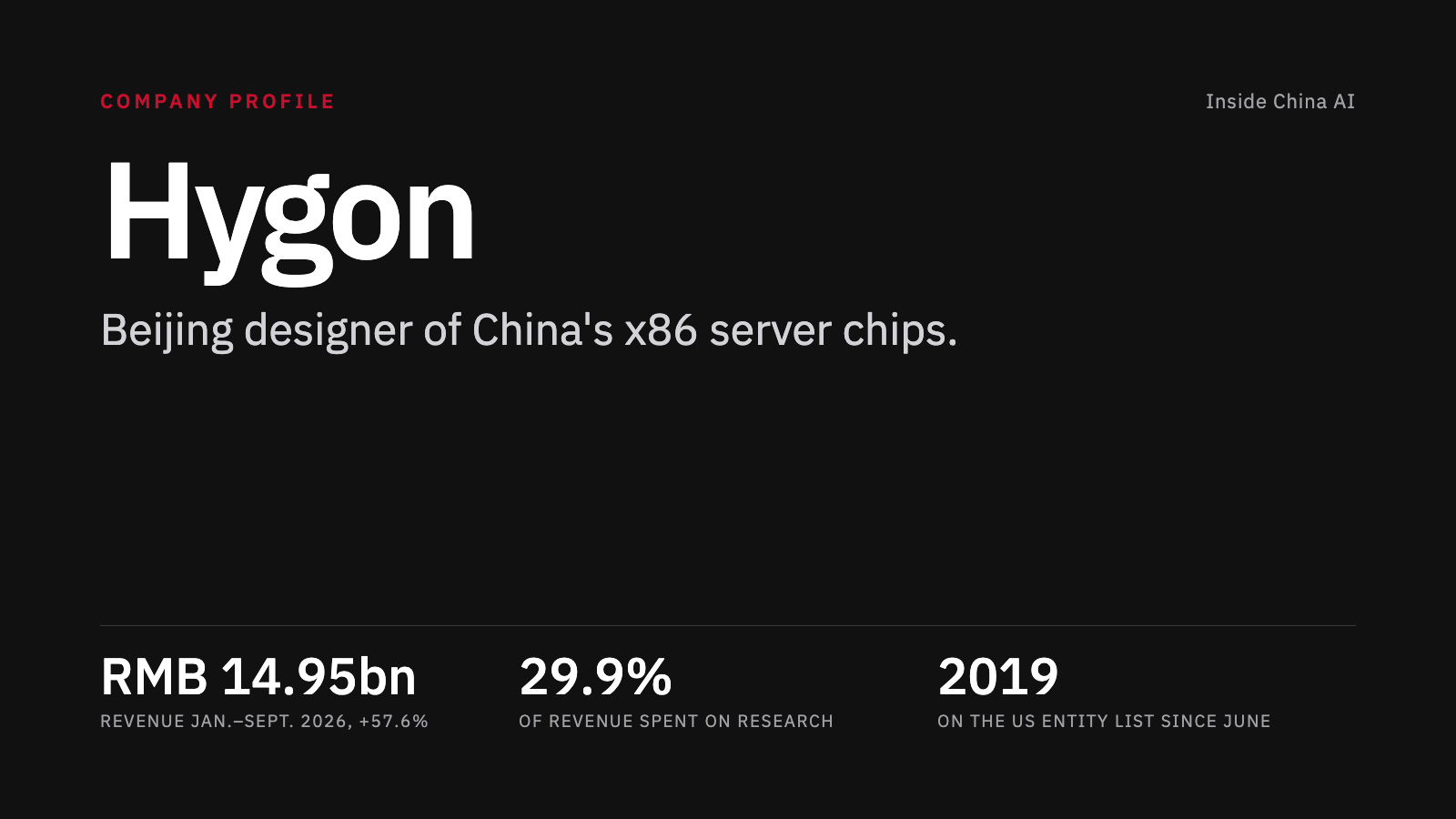
Hygon designs x86-compatible server processors and GPU-style accelerators for data centres and AI, and sells them almost entirely to Chinese server makers. In the first nine months of 2026 its revenue rose 57.58 per cent to RMB 14.95 billion. In 2025 and the first half of 2026 it booked all of its revenue in mainland China, Hong Kong, Macau and Taiwan, and it has been on the US Entity List since 24 June 2019. For Europe, Hygon is not a supplier. It matters because its chips are one of the domestic platforms on which Chinese cloud providers and model makers run AI.
Origins and backing
Hygon Information Technology Co., Ltd. (海光信息) was set up on 24 October 2014 by Tianjin Haitai Technology Investment Management, a company controlled by the administrative committee of the Tianjin Binhai Hi-tech Zone (IPO prospectus, 2022). It is registered in Tianjin, has its offices in Beijing’s Zhongguancun Software Park and has been listed on the Shanghai Stock Exchange’s STAR Market (688041) since 12 August 2022 (annual report 2025).
The CPU business began with a licence from AMD. According to its IPO prospectus of August 2022, Hygon obtained high-end processor technology and technical support from AMD; after Hygon was put on the US Entity List, AMD stopped providing technical services and Hygon developed later products on its own. (IPO prospectus).
Hygon has no controlling shareholder and no actual controller, the company says (annual report 2025). On 30 September 2026 its largest shareholder was the server maker Sugon with 27.96 per cent, followed by the Tianjin partnership Haifu Tianding with 10.81 per cent; three Chengdu companies classed as state-owned held 7.21, 5.92 and 3.87 per cent (third-quarter report). The two companies share a chairman: Li Jun, chairman of Sugon since 6 May 2026 (Sugon board notice), was elected chairman of Hygon’s new board on 28 September 2026; Sha Chaoqun was reappointed president the same day (board notice).
A plan for Hygon to absorb Sugon through a share swap, announced with a trading halt on 26 May 2025, was called off by Hygon’s board on 9 December 2025; the company said the market environment had changed considerably and the conditions were “尚不成熟”, not yet mature (termination notice). The two still invest together: in October 2026 each committed RMB 70 million, for 4.67 per cent, to a new Hefei company for satellite remote sensing and space computing (investment notice).
What they build
Hygon designs two kinds of chips. Its CPUs are compatible with the x86 instruction set and come in a 7000 series for high-end servers, a 5000 series for general servers and a 3000 series for workstations and industrial equipment. Its DCUs, in the 8000 series, are coprocessors based on a general-purpose GPU architecture, which the company says are used for big data, AI and the training and inference of large models. Hygon is fabless and does not name its foundry. Its main customers are server makers, and it sells mostly directly (annual report 2025).
The AI side rests on its own DTK software stack. Hygon says that by 30 June 2026 its DCUs had been adapted to more than 400 models, including DeepSeek, Qwen3, Tencent‘s Hunyuan and Zhipu‘s models. It names government departments, state-owned banks, telecom operators and internet companies as unnamed DCU customers, and says its partner network, the “Photosynthesis Organisation”, has more than 6,000 members (H1 2026 report). We found no AI models of its own.
Chinese AI companies report running on Hygon. Megvii said in July 2026 that its vision foundation model ran inference 30 per cent faster on Hygon accelerators after joint optimisation (Inside China AI); Zhipu’s GLM-5 models run inference on Hygon among other domestic chips (Inside China AI). In August 2026 UCloud added Hygon accelerators to its public cloud, scale undisclosed (TechNode, citing Yicai). Its market share is still small: IDC put Hygon at 3 per cent of China’s data-centre AI accelerator shipments in the first half of 2026, as reported by Reuters and TechNode on 14 October 2026.
Hygon is also moving towards devices. On 22 September 2026 it launched its first embedded processor for industrial control, the 1000 series, for controllers, industrial robots and edge gateways. President Sha Chaoqun said computing power was moving from the cloud to the edge and AI was heading into the physical world (STAR Market Daily).
Growth comes with concentration and a heavier balance sheet. In 2025 the five biggest customers accounted for 90.28 per cent of sales; the largest, a related party Hygon does not name, alone accounted for 56.68 per cent, and the company says it bought much more for a “special project” (annual report 2025). In the first nine months of 2026 operating cash flow was minus RMB 2.44 billion, while inventory rose from RMB 6.41 billion at the end of 2025 to RMB 8.92 billion on 30 September 2026; Hygon says it increased its stocking to secure supply (third-quarter report).
Key numbers
- Revenue RMB 5.86 billion in the third quarter of 2026 (+45.46%), RMB 14.95 billion in January–September (+57.58%) (Q3 report); RMB 14.38 billion in 2025 (+56.92%) (annual report 2025)
- Net profit RMB 1.05 billion in the third quarter (+37.90%), RMB 2.85 billion in January–September (+45.12%), attributable to shareholders (Q3 report)
- Research RMB 4.47 billion in January–September 2026, 29.90% of revenue (Q3 report); 3,007 R&D staff, 80.83% of all employees, on 30 June 2026 (H1 2026 report)
- Where it sells 100% of revenue in mainland China, Hong Kong, Macau and Taiwan, in 2025 and in the first half of 2026 (H1 2026 report)
- Largest shareholder Sugon, 27.96% on 30 September 2026; no controlling shareholder (Q3 report)
- Listing Shanghai STAR Market, 688041, since 12 August 2022
The European angle
- Physical presence None. Hygon’s website lists offices only in Beijing, Chengdu, Shanghai and Suzhou (Hygon), and its filings show no assets outside China (H1 2026 report). We found no European subsidiary, distributor, partner or named customer.
- Sales None outside mainland China, Hong Kong, Macau and Taiwan in 2025 or the first half of 2026, a category the filings do not break down (annual report 2025).
- Export controls Three Hygon entities have been on the Entity List, the export-control list of the US Commerce Department’s Bureau of Industry and Security, since 24 June 2019. Hygon itself is listed as “Higon”, with aliases including “Higon Information Technology” and an address in Tianjin; its 70 per cent subsidiary Chengdu Haiguang Integrated Circuit is listed with the alias “Hygon”, and Chengdu Haiguang Microelectronics Technology, in which Hygon holds 49 per cent, with the alias “HMC” (annual report 2025). For all three the rule sets a licence requirement for all items subject to the US Export Administration Regulations (EAR), with a presumption of denial, and says they “pose a significant risk of being or becoming involved in activities contrary to the national security and foreign policy interests of the United States” (Federal Register). A rule published on 13 October 2022 gave all three entries, among 28, a new footnote effective 21 October 2022; with it, “additional foreign-produced items will now be subject to the EAR and require a license when destined to or for these 28 entities” (Federal Register). Hygon names the listing as a reason suppliers might stop working with it (H1 2026 report).
- Sanctions and other lists The Entity List is an export control, not a sanction. According to our check of the published lists on 27 November 2026, Hygon is not on the EU’s consolidated financial sanctions list, the US investment-ban list of Chinese military-industrial complex companies, or the Pentagon’s 1260H list of Chinese military companies, which is not a sanctions list. Separately, its largest shareholder Sugon is on all three US lists; those entries concern Sugon, not Hygon.
- What a European buyer would actually encounter Not Hygon hardware, but possibly Chinese cloud and model services that run on it.
What we could not verify
- Who the largest customer is. Hygon calls it a related party and does not name it.
- Which foundry makes the chips, on which process, and the specifications of the newest generations. The filings give only series numbers.
- Who holds the remaining 51 and 30 per cent of the two Chengdu subsidiaries. The 2025 report does not say.
- Which associate Hygon and Sugon put new capital into in October 2026. Hygon withheld the name as a trade secret (investment notice).
The open question for Europe: as Chinese clouds move more AI workloads onto domestic accelerators like Hygon’s, will they say which hardware runs the services European customers use?

Comments are closed